
MRO Spend Visibility: Why Companies Struggle to See Where Their Procurement Dollars Go
The invoice was posted. The purchase order was approved. The ERP report still cannot tell the category manager what the business really bought. Illustration: conceptual workflow; figures and interfaces are not customer data. Maintenance, repair, and operations (MRO) purchasing rarely follows one tidy path. One plant orders safety gloves from ...
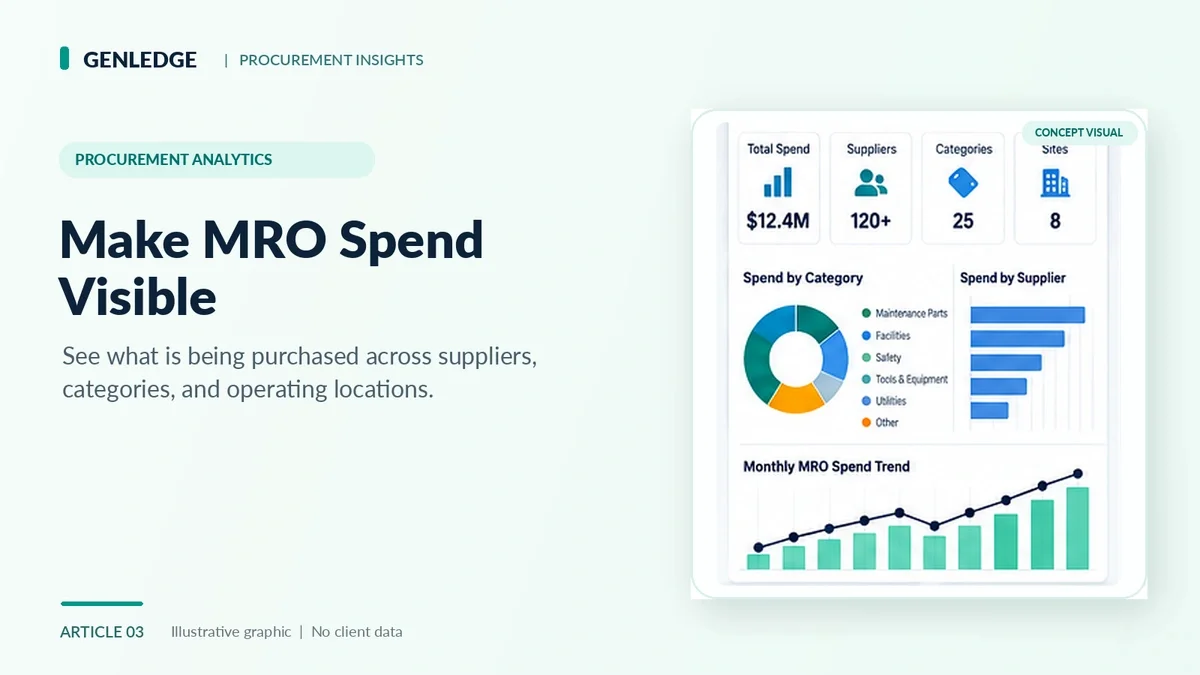
The invoice was posted. The purchase order was approved. The ERP report still cannot tell the category manager what the business really bought.
Maintenance, repair, and operations (MRO) purchasing rarely follows one tidy path. One plant orders safety gloves from an approved supplier. Another buys similar products using a different description. A technician orders an urgent replacement part, a facilities team buys consumables, and a vendor invoice arrives with a broad charge description. Each transaction may be valid. Viewed together, they are hard to manage.
A company can have a mature ERP and still lack meaningful MRO spend visibility. The system records transactions. It does not automatically reconcile duplicate materials, normalize supplier names, classify descriptions, or explain why equivalent products are bought at different prices.
What does MRO spend visibility actually mean?
MRO spend visibility is the ability to see what the organization purchases for maintenance and operations, from whom, in what quantity, at what effective price, for which location, and under which category or agreement. It is not simply a total-dollar chart by supplier.
For a procurement leader, a useful view should answer practical questions: Which items are repeatedly purchased across sites? Where are we buying off contract? Which suppliers dominate a category? Where has the effective unit price changed? Where are teams buying externally while equivalent stock exists internally?
If those questions still require manual spreadsheets, the organization has transaction reporting, not operational spend intelligence.
Why the ERP report alone is not enough
Most procurement data is distributed across purchase orders, receipts, invoices, supplier records, contracts, and item masters. Each source solves a different operational need. A general ledger may report the cost center accurately while concealing the material purchased. A purchase order may contain the item details but not the final credit or rebate. A supplier file may include duplicates caused by trading names or regional entities.
The same physical item can also appear under multiple text descriptions and units. Comparing a case price with a unit price without conversion can create an apparent variance where none exists. Conversely, aggregating everything under “maintenance supplies” can hide a genuine opportunity.
This is why visibility begins with standardized data, not with a more colorful dashboard.
From fragmented records to an actionable spend view
A reliable process has five linked layers:
- Bring transactions together. Combine relevant purchase-order, invoice, supplier, and material data for a consistent reporting period.
- Clean the common dimensions. Normalize supplier identifiers, item descriptions, currencies, and units of measure; identify potential duplicate item records.
- Classify with context. Group transactions into usable spend categories, retaining a connection to the original material and accounting records.
- Calculate meaningful comparisons. Compare effective unit prices, contracted versus noncontracted buying, supplier concentration, and demand by location.
- Assign actions and track results. Give category owners a defensible opportunity list, record decisions, and measure whether the expected improvement actually materializes.
AI agents can assist with the messy interpretation and categorization. Rules and approved source data should perform the numerical comparisons and financial calculations. Managers remain accountable for supplier and category decisions.
The difference between visibility and savings
Imagine two facilities buying functionally equivalent gloves from separate suppliers. A consolidated view could reveal a sourcing opportunity. But a lower quoted price is not yet a realized saving. The manager still needs to compare specifications, freight, minimum order quantities, delivery reliability, negotiated terms, and actual purchase volumes.
Good spend analytics therefore distinguish four states: an identified opportunity, an approved sourcing action, a contracted or implemented change, and a realized financial outcome. Combining all four into one “savings” number is an invitation to overstate impact.
The same discipline matters with inventory. A report may flag duplicate stock, but the inventory cannot automatically be counted as released working capital until the business verifies that the stock is transferable, usable, and genuinely excess.
Metrics procurement leaders should watch
Start with a small group of measures that support decisions. Spend under management shows how much purchasing is governed by an active sourcing approach. Contract compliance reveals whether teams buy at agreed terms. Purchase price variance can show changes after units and specifications are normalized. Supplier concentration highlights fragmentation or exposure. Finally, realized savings should be reconciled against an agreed baseline.
For operations, look at urgent purchases, repeated stockouts, and where requisition-to-PO cycle time creates delays. Together, these measures connect the sourcing strategy to service levels and cost.
You do not need a new ERP to start
Many organizations can begin with scheduled exports from their current systems. A periodic file-based refresh will not provide live alerts, but it can be enough to establish a category baseline, prioritize cleanup, and identify initial opportunities. Live integrations make sense when the decisions require fresher information or when approved actions need to flow back to operational systems.
GenLedge's approach brings data standardization, AI-assisted analysis, and controlled procurement execution into the same operating model. It is possible to begin with a specific category and expand only after the output proves useful.
Five questions to test your current spend visibility
Can a category manager trace a dashboard number to the actual purchase lines? Do equivalent items appear together? Are unit prices comparable after pack-size conversion? Can you separate proposed savings from realized savings? And does someone own the next action when a variance appears?
A report that cannot answer those questions may be attractive without being actionable.
FAQ
Is MRO the same as indirect spend? MRO is usually part of indirect spend, but company definitions differ. Align the scope before comparing reports.
Why can't we use only general ledger categories? GL categories are designed for accounting, not detailed item- and supplier-level sourcing analysis.
Does a spend dashboard need real-time ERP integration? Not always. Periodic exports can support baseline analysis; operational alerts may need more frequent data.
What is the first useful outcome? A trusted category view with prioritized opportunities, owners, and evidence, rather than a long list of disconnected metrics.
The dashboard is not the decision
Procurement value comes when a team can move from “we spent more” to “here is the item, supplier, reason, owner, and next action.” Better data and agent-assisted analysis shorten that distance.
Make your spend data actionable. Book a free AI workshop to explore how GenLedge can help connect category visibility with controlled procurement workflows.
Related reading: GenLedge procurement automation.
Related articles
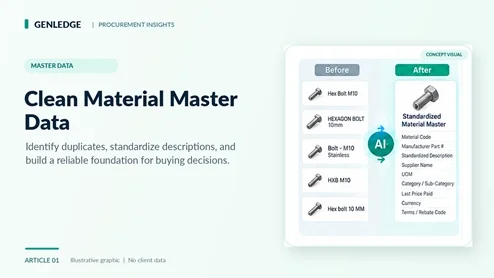
AI-Powered Material Master Data Cleansing: From Duplicate Parts to Reliable Procurement Data
The maintenance technician asks for a replacement bearing. The buyer searches the ERP and finds “BRG 6205,” “6205 bearing,” and “deep-groove ball bearing 6205.” They might be the same item. They might differ in sealing, clearance, or manufacturer. The buyer has to open records, compare specifications, and decide which one ...
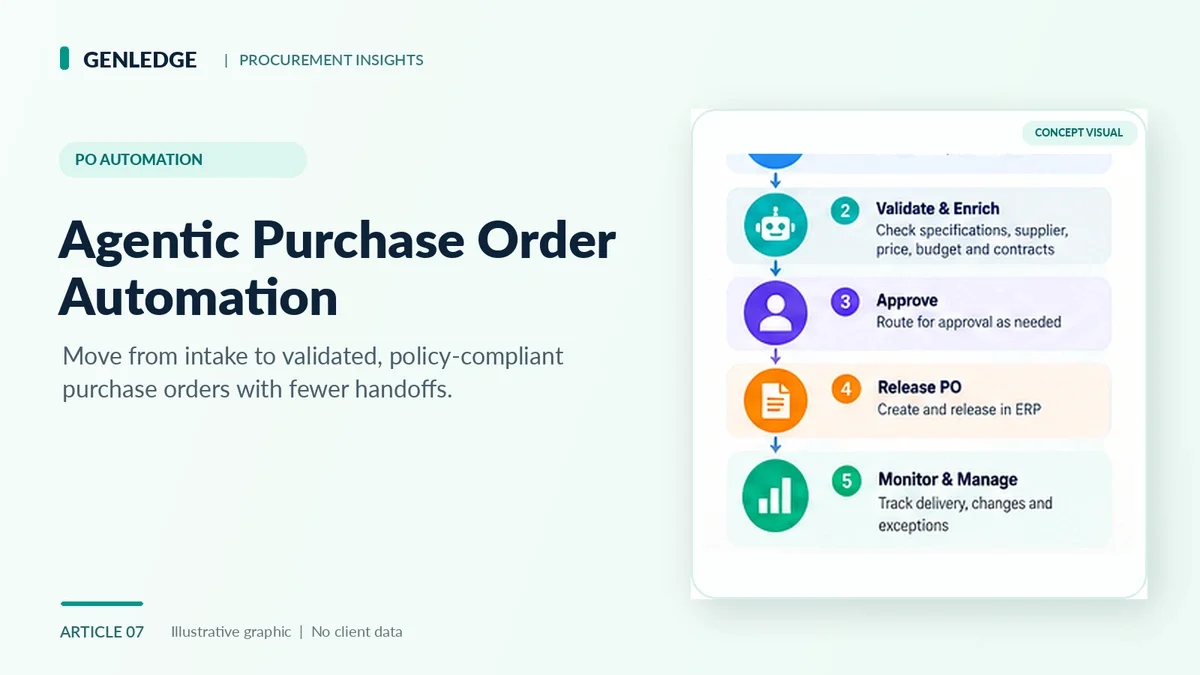
Agentic Purchase Order Automation, Explained: From Purchase Request to Released PO
A maintenance manager emails: “Need two replacement drives for next week's shutdown.” The buyer asks for specifications, looks up approved suppliers, checks stock, finds an old quote, verifies a budget, creates the requisition, and routes an approval. Only then does the purchase order get released. One request can cross multiple ...

ERP implementation for small business: a step-by-step path to go-live without the chaos
A growing small business that has outgrown its QuickBooks or Xero setup knows it needs a real ERP. But the thought of an ERP implementation for small business can freeze the finance team. The fear is real: a botched rollout can stall billing, payroll, or month-end close. It does not ...
See GenLedge on your own data
Book a free AI workshop and we'll set up a sandbox with your real data so you can judge it for yourself, before you commit to anything.