Agentic Purchase Order Automation, Explained: From Purchase Request to Released PO
A maintenance manager emails: “Need two replacement drives for next week's shutdown.” The buyer asks for specifications, looks up approved suppliers, checks stock, finds an old quote, verifies a budget, creates the requisition, and routes an approval. Only then does the purchase order get released. One request can cross multiple ...
A maintenance manager emails: “Need two replacement drives for next week's shutdown.” The buyer asks for specifications, looks up approved suppliers, checks stock, finds an old quote, verifies a budget, creates the requisition, and routes an approval. Only then does the purchase order get released. One request can cross multiple people and systems before the supplier receives an actionable order.
Traditional purchase-order automation may speed up a form or route an approval. Agentic PO automation aims to complete the preparatory work across the process, bringing people in for the decisions that require judgment or authority.
What is agentic purchase order automation?
Agentic PO automation uses AI agents and business rules to turn incoming purchase needs into validated, approval-ready procurement transactions. Rather than expecting a buyer to rekey the request and gather every missing detail, the workflow reads the request, interprets it, checks the relevant records, prepares a structured requisition or purchase order, and guides it through the organization's controls.
The endpoint is important. An extracted shopping list is not a purchase order. An approved order requires the right item, quantity, supplier, commercial terms, delivery details, and authority to commit spend.
Why requisition-to-PO still takes so much work
Requests arrive through email, messaging, forms, documents, and verbal follow-ups. They rarely contain every field that purchasing needs. Specifications may be incomplete. A quoted price may have expired. Stock may already exist internally. A budget owner may need to confirm the cost center. And the buyer has to decide whether the request falls under an existing contract or needs sourcing.
Every missing detail creates a handoff. Even when an ERP has a purchase-requisition module, a person may still have to interpret the original request and assemble the evidence before entering it.
The opportunity is to let software do the gathering and checking while the requester, buyer, and approver retain their roles.
What an agent does from intake to PO, step by step
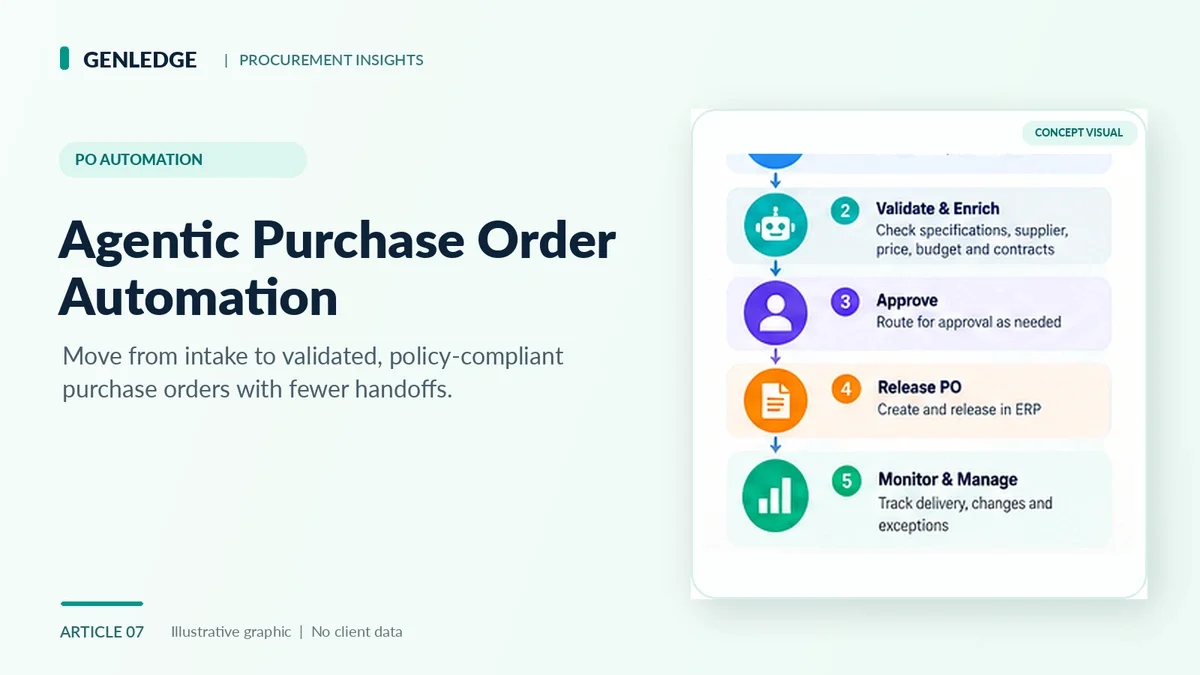
A controlled workflow can follow eight stages:
- Capture the need. Read an email, document, or structured form and extract requested items, quantities, destination, required date, and business context.
- Check completeness. Identify missing specifications or ambiguous descriptions and draft a targeted question to the requester rather than guessing.
- Match items and availability. Find candidate catalogue items, normalize units, and check on-hand or approved substitute stock where data is available.
- Validate sourcing context. Check supplier eligibility, existing contracts, quote details, lead times, and restrictions relevant to the purchase.
- Check price and policy. Compare quoted or contracted prices, evaluate budget and approval thresholds, and flag potential duplicates or exceptions.
- Prepare the transaction. Build a structured requisition or PO draft with lines, delivery details, terms, and supporting evidence.
- Route decisions. Send the request to the correct approver or buyer, with the reasons for any exceptional recommendation.
- Release under authority. Once approvals and release conditions are satisfied, process the order through the organization's approved procedure and retain an audit trail.
GenLedge's procurement approach combines document interpretation with policy-led validation and human-owned approvals. The result should be less repetitive work, not weaker controls.
A hypothetical request that should not go straight through
Imagine an engineer asks for “ten stainless fittings” to arrive Friday. The system cannot safely create the order until size, connection type, pressure rating, and ship-to location are clear. A weak automation may choose the first matching catalogue item. A well-designed agent flags the missing attributes, drafts a clarification, and holds the transaction.
After the engineer confirms the specification, the workflow can identify a matching item, verify the supplier and price, prepare the order, and present it for approval. The agent removes the mechanical work while avoiding an unjustified technical decision.
This scenario is hypothetical and uses no customer data.
Straight-through processing should be earned
Some repeat purchases are predictable: an approved catalogue item, known supplier, unchanged contract, clear budget, and low-risk quantity. These are candidates for a more automated path. Other requests involve new suppliers, unusual prices, nonstandard specifications, missing information, or material operational risk.
The organization should define what requires review, what can proceed under established approval rules, and who is authorized to release the PO. Confidence thresholds can help decide which information needs confirmation, but a high language-model confidence score does not override procurement policy.
A useful operating model starts with full visibility and expands straight-through handling for proven, routine categories.
What changes for the procurement team?
Buyers spend less time copying requests into ERP fields and more time handling supplier negotiations, exceptions, and sourcing strategy. Requesters receive more focused questions instead of repeated calls. Approvers can see a complete decision brief rather than a bare total amount.
Measure requisition-to-PO cycle time, manual touches per request, incomplete-request rate, price or supplier exceptions, approval turnaround, and PO rework. Keep a separate view of actual straight-through processing. A process is not touchless if a buyer must quietly repair every draft.
Five questions to ask when evaluating PO agents
Can the system ask for missing specifications? Does it check contracts and budgets before drafting a PO? Can it identify duplicate requests and available stock? Are approvals and release authority enforceable? Can a buyer trace every proposed line back to the request, quotation, or catalogue record?
These questions distinguish a workflow agent from a screen-filling shortcut.
FAQ
Will an agent choose the supplier without our approval? It may compare options and recommend a supplier, but the final choice should follow the organization's sourcing and approval policies.
What happens if the item description is incomplete? The workflow should request clarification or route the case for review rather than invent critical specifications.
Does PO automation need to replace the ERP? No. It can be designed to work with existing procurement systems and approved integration paths.
Can every purchase order be released automatically? No. Exceptions, approval limits, and business-critical purchases may require human authorization.
Stop making buyers assemble the same facts repeatedly
Procurement's expertise should be spent on commercial judgment, not collecting information that already exists across emails, catalogues, and system records. Agentic PO automation connects those fragments into a controlled decision.
See the intake-to-PO workflow. Book a free AI workshop and explore how GenLedge can prepare, validate, and route purchase orders with the controls your team needs.
Related reading: GenLedge procurement automation and Procurement in GenLedge ERP
Related articles
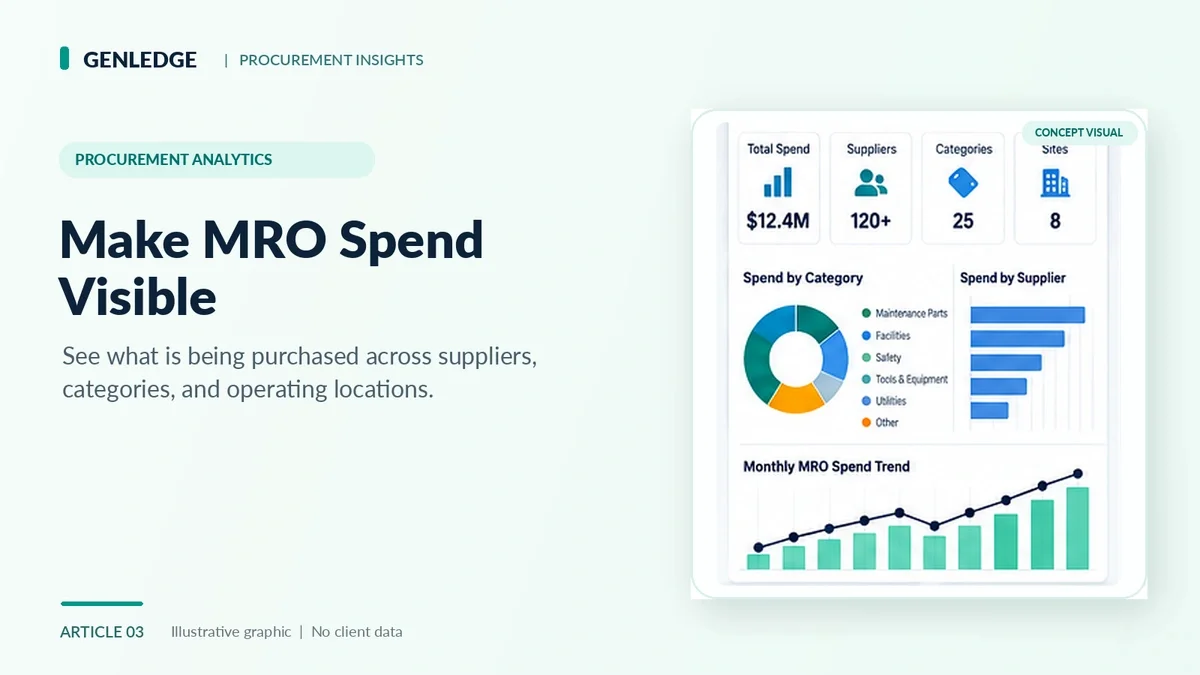
MRO Spend Visibility: Why Companies Struggle to See Where Their Procurement Dollars Go
The invoice was posted. The purchase order was approved. The ERP report still cannot tell the category manager what the business really bought. Illustration: conceptual workflow; figures and interfaces are not customer data. Maintenance, repair, and operations (MRO) purchasing rarely follows one tidy path. One plant orders safety gloves from ...
AI-Powered Material Master Data Cleansing: From Duplicate Parts to Reliable Procurement Data
The maintenance technician asks for a replacement bearing. The buyer searches the ERP and finds “BRG 6205,” “6205 bearing,” and “deep-groove ball bearing 6205.” They might be the same item. They might differ in sealing, clearance, or manufacturer. The buyer has to open records, compare specifications, and decide which one ...

ERP implementation for small business: a step-by-step path to go-live without the chaos
A growing small business that has outgrown its QuickBooks or Xero setup knows it needs a real ERP. But the thought of an ERP implementation for small business can freeze the finance team. The fear is real: a botched rollout can stall billing, payroll, or month-end close. It does not ...
See GenLedge on your own data
Book a free AI workshop and we'll set up a sandbox with your real data so you can judge it for yourself, before you commit to anything.