AI-Powered Material Master Data Cleansing: From Duplicate Parts to Reliable Procurement Data
The maintenance technician asks for a replacement bearing. The buyer searches the ERP and finds “BRG 6205,” “6205 bearing,” and “deep-groove ball bearing 6205.” They might be the same item. They might differ in sealing, clearance, or manufacturer. The buyer has to open records, compare specifications, and decide which one ...
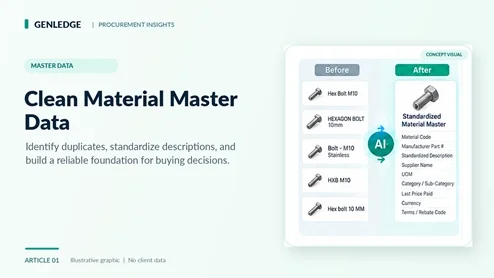
The maintenance technician asks for a replacement bearing. The buyer searches the ERP and finds “BRG 6205,” “6205 bearing,” and “deep-groove ball bearing 6205.” They might be the same item. They might differ in sealing, clearance, or manufacturer. The buyer has to open records, compare specifications, and decide which one to order. Multiply that uncertainty across a storeroom and a purchasing team, and the material master stops being a source of truth.
This is not a data-entry problem alone. It is a buying, inventory, and spend-visibility problem. If identical items are listed separately, teams cannot confidently consolidate demand or compare prices. If different items get merged by mistake, the operational risk is even worse. Material master data cleansing should solve both problems, not simply make descriptions look tidy.
What is material master data cleansing?
Material master cleansing is the process of finding inaccurate, incomplete, inconsistent, or duplicate item records and improving them into a reliable, governed catalogue. A good record answers: What is the item? How is it identified? Which specifications matter? Who makes and supplies it? In what unit is it purchased and stocked? Where is it used?
Traditional cleanup often means exporting a spreadsheet, sorting descriptions, and asking an expert to work down the rows. That can fix a one-time backlog. It does little for the next shipment of supplier data, the next acquisition, or the next project that creates new item codes.
The better goal is a repeatable control: clean existing data, preserve important distinctions, and validate new items before duplicates enter the system.
Why material records become unreliable
Descriptions arrive from requisitions, vendor quotes, catalogues, invoices, and legacy ERP migrations. One supplier uses a manufacturer's part number. Another sends its own stock-keeping unit. One plant records “EA”; another buys a box of ten. Abbreviations, punctuation, languages, and missing attributes make a straightforward lookup surprisingly difficult.
The hardest cases are near-duplicates. Two records may refer to the same component under different names. Conversely, two items may share a model family but have different materials, tolerances, or dimensions. A system that merges on text similarity alone will eventually get something important wrong.
That is why cleansing should combine language understanding with deterministic checks against part numbers, product attributes, and business rules. It should also record where each proposed change came from.
How an AI-assisted cleansing workflow works
A well-governed workflow can follow six steps:
- Read and profile the source. Ingest a material or purchase-order export and identify the available fields, missing values, abbreviations, units, and suspicious patterns.
- Normalize descriptions. Expand recognized abbreviations and arrange attributes consistently, for example: item type, size, grade, material, and distinguishing specification.
- Match candidate records. Compare descriptions alongside manufacturer part numbers, supplier references, units of measure, dimensions, and other available evidence.
- Separate matches from lookalikes. Mark likely duplicates for consolidation while keeping items apart when specifications conflict or evidence is incomplete.
- Classify and enrich. Suggest a standardized category, meaningful attributes, and a clearer description. Record confidence and the supporting evidence.
- Review, approve, and publish. Route uncertain or consequential changes to a material-data owner, then update the governed master through the organization's approved process.
Notice the sequence. An AI suggestion is not the same as an approved master-data change. Human review is essential when item interchangeability affects safety, production, or maintenance.
A simple example: three names, one possible part
Imagine an illustrative purchase file with “MTR BELT A42,” “V-BELT A 42,” and “BELT, DRIVE, A42.” Those descriptions suggest a match, but a buyer should still check profile, length designation, and manufacturer specifications before consolidating the records. The clean output would preserve the original references and propose a standard description only after those checks.
Now consider “A42” versus “AX42.” A superficial text match could be dangerously misleading. The workflow must recognize when a specification is not an optional detail. Getting the distinction right matters more than maximizing the number of records merged.
This example is hypothetical; it does not use a customer dataset.
What changes for procurement and operations?
Better material data is valuable because of the decisions it enables. Buyers can search for an item without guessing which description is correct. Category managers can see total demand for equivalent materials. Inventory teams can identify potential duplication across sites. Finance can distinguish true price differences from false variances caused by inconsistent units or descriptions.
The useful measures are not only “records cleaned.” Track duplicate candidates resolved, category coverage, unknown manufacturer references, request-to-item-match time, new duplicate creation, and changes requiring human review. For inventory-intensive businesses, also track how cleansing affects duplicate purchases and available-stock visibility.
How to begin without disrupting the ERP
A pragmatic first phase can use an exported material file and selected transaction data rather than changing live ERP records immediately. Agree the minimum required attributes, build a sample of verified items, review candidate duplicates with people who know the parts, and test the confidence thresholds before making any updates.
Once the rules work on historical data, apply the same process to new item creation. Otherwise, the organization simply cleans the backlog while generating the next one.
GenLedge's approach is to connect AI-assisted interpretation and classification with a controlled workflow: the system prepares the work, while policy and authorized people govern consequential changes. The purpose is not to replace your ERP. It is to make the data inside it useful enough to automate the next step.
Five questions to ask before buying a cleansing solution
Does it check product attributes beyond names? Can it explain why two records are considered duplicates? Does it preserve original item IDs and supplier references? Can a reviewer reject or modify a suggestion? And can the process continue when new items arrive, rather than stopping after a one-time cleanup?
If the answer to those questions is unclear, the tool may produce a prettier spreadsheet without delivering a trustworthy master.
FAQ
Is a standardized description enough to prevent duplicate materials? No. Descriptions help people search, but material identity also depends on specifications, part numbers, units, and rules for substitutability.
Will AI automatically merge every suspected duplicate? It should not. High-risk or uncertain matches need qualified review. The approval threshold depends on the business and the material.
Do we have to replace our current ERP? No. Organizations can start with exports and governed imports, then consider integrations if they make operational sense.
How is this different from manual data cleanup? AI helps interpret messy descriptions and produce candidate matches at scale. Deterministic validation, owner review, and ongoing governance make the results dependable.
Clean data is the start of automation, not the finish
Purchase-order automation, spend analytics, and inventory planning are only as reliable as the items they reference. Before asking AI to buy faster, make sure it can identify what the business is buying.
See it on your own workflow. Book a free AI workshop to explore how GenLedge can help standardize material data and reduce manual procurement work.
Related reading: GenLedge procurement automation
Related articles
MRO Spend Visibility: Why Companies Struggle to See Where Their Procurement Dollars Go
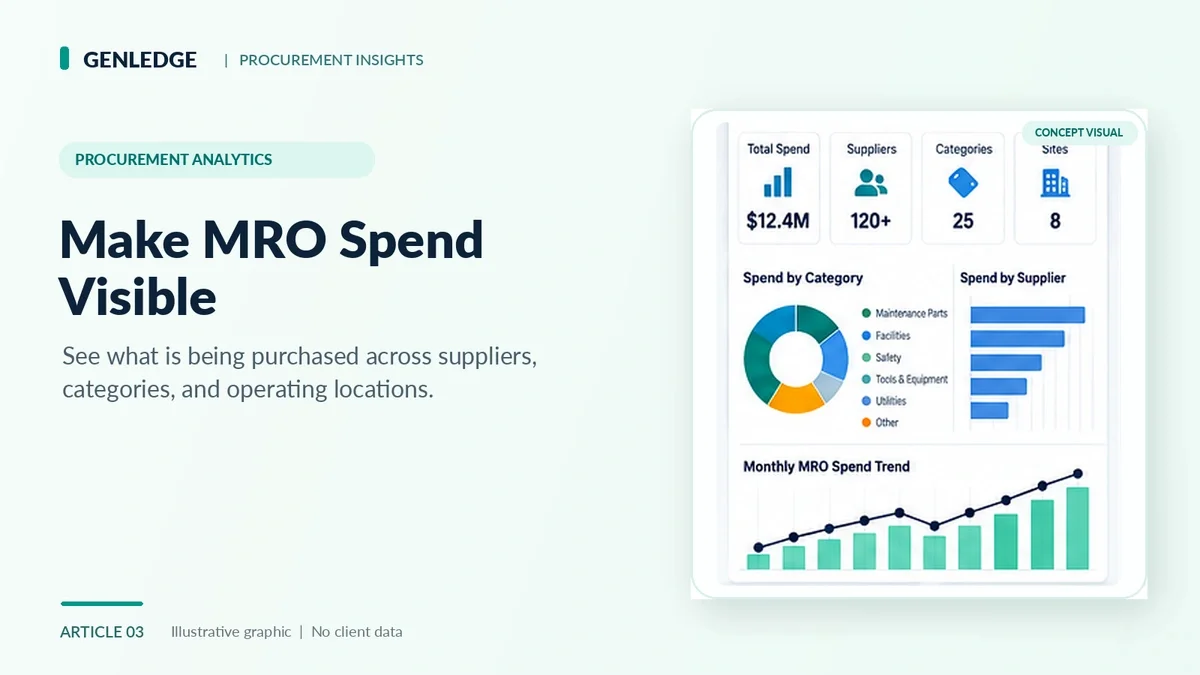
The invoice was posted. The purchase order was approved. The ERP report still cannot tell the category manager what the business really bought. Illustration: conceptual workflow; figures and interfaces are not customer data. Maintenance, repair, and operations (MRO) purchasing rarely follows one tidy path. One plant orders safety gloves from ...
Agentic Purchase Order Automation, Explained: From Purchase Request to Released PO
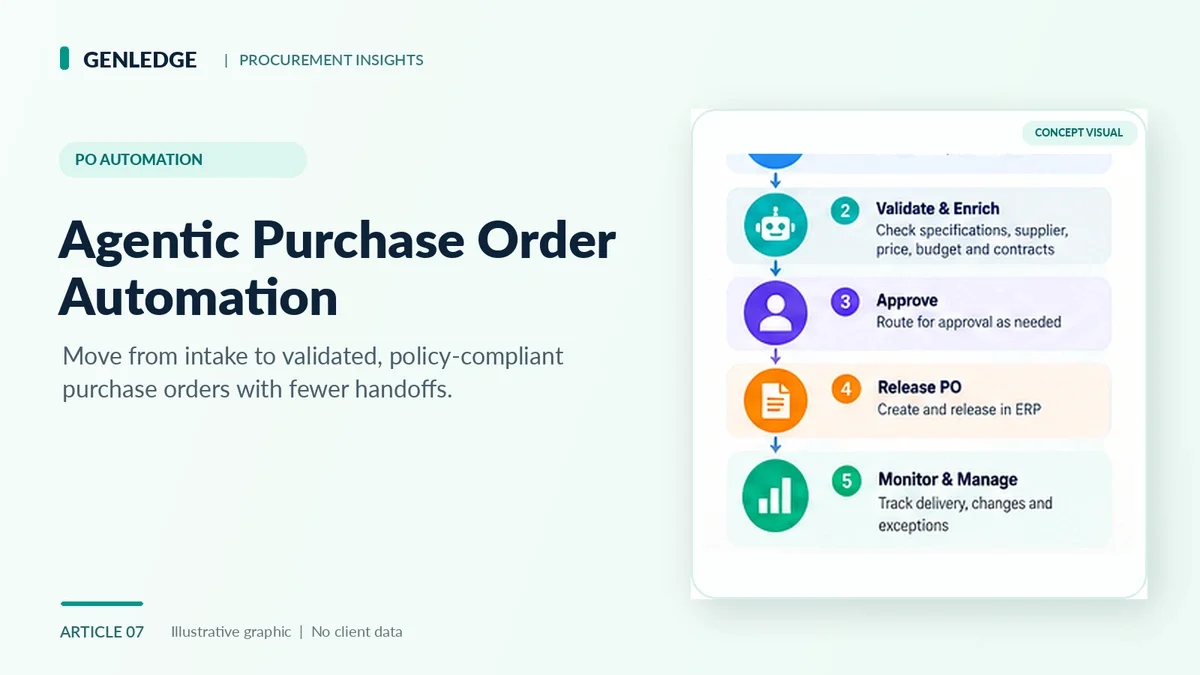
A maintenance manager emails: “Need two replacement drives for next week's shutdown.” The buyer asks for specifications, looks up approved suppliers, checks stock, finds an old quote, verifies a budget, creates the requisition, and routes an approval. Only then does the purchase order get released. One request can cross multiple ...

ERP implementation for small business: a step-by-step path to go-live without the chaos
A growing small business that has outgrown its QuickBooks or Xero setup knows it needs a real ERP. But the thought of an ERP implementation for small business can freeze the finance team. The fear is real: a botched rollout can stall billing, payroll, or month-end close. It does not ...
See GenLedge on your own data
Book a free AI workshop and we'll set up a sandbox with your real data so you can judge it for yourself, before you commit to anything.